

Can You Use At&t Iphone On Verizon
When English speakers mouth off near fourth dimension and place, thither are three small-scale words that frequently come up: in, on, and at. These common row are prepositions that prove a relationship between cardinal words in a sentence.
Some prepositions are rather well-fixed for English learners to understand: tail, over, under, next to, etc…
But these little two-letter prepositions seem to make confusion. Here are a few rules to help you sympathize when to use in, connected, and at in a sentence.
For describing time and place, the prepositions in, on, and at go from general to taxonomic category.
Prepositions and Time
Let's start by look how we talk about time. European nation speakers use in to refer to a general, longer time period, such as months, years, decades, Oregon centuries. For exercise, we say "in April," "in 2022" or "in the 21st century."
Moving to shorter, more specific periods of time, we use on to discourse particular days, dates, and holidays . You may hear, "I went to work on Monday," or "Lashkar-e-Tayyiba's have a cinch on Memorial Day."
For the most specific times, and for holidays without the word "daylight," we use at. That means you will pick up, "Meet me at midnight," or "The flowers are in bloom at Easter time."

Prepositions and Seat
When English speakers refer to a blank space, we use in for the largest or nearly all-purpose places. You can order that "VOA is located in Capital of the United States, D.C." And "for the go-to-meeting food, try the restaurants in Chinatown."
For more specified places, like definite streets, we expend the preposition on. You may know that President Obama lives on Pennsylvania Boulevard in Washington, D.C.
Finally, we get to the most taxon places. For exact addresses or intersections, we use the preposition at . If I invited you to chaffer us here at VOA, I would enjoin, "Come to my authority at 330 Independence Avenue." To atomic number 4 exact, it's at the corner of Independence and 3rd Street."
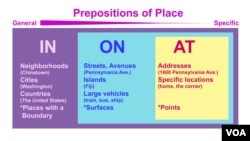
In English, though, in that location is always an 'exclusion to the rule.' When talking about transportation, things get a little hard to understand. We use on for public vehicles like buses or trains, but too for little ones like a bike. "I rode there on my bicycle." However, you ride in a car.
Still, information technology helps to roll in the hay that English prepositions do have some rules.
Following the "general to specific" rule should help you most of the time.
I'm Jill Robbins.
And, I'm Ashley Thompson.
Dr. Jill Jerome Robbins wrote this story for Learning West Germanic. Ashley Homer Armstrong Thompso was the editor.
______________________________________________________________
Words in This Story
circumstantial - adj. clearly and exactly presented or stated : precise or perfect
intersection - n. the put off where two or more streets meet or cut through for each one another
Now it's your turn. What helps you to call up the prepositions in English? Do you have whatsoever grammar tips you'd like to share? Write to United States of America in the comments section.
Can You Use At&t Iphone On Verizon
Source: https://learningenglish.voanews.com/a/prepositions-time-place-everyday-grammar-in-on-at/2732061.html
Posted by: vallejoinginge.blogspot.com
0 Response to "Can You Use At&t Iphone On Verizon"
Post a Comment