

Which Of The Following Correctly Describes The Size Of Meteoroids?
What's the Difference Betwixt Asteroids, Comets and Meteors?
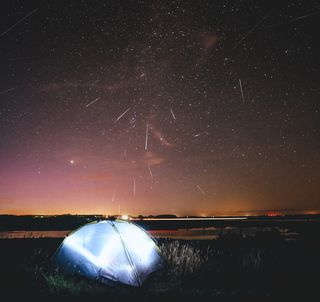
In our solar system there are billions, possibly trillions, of rogue objects orbiting the lord's day. These spacefarers are likewise small to be called planets and are given the names of comets, asteroids, meteoroids, and if they reach Earth, meteors or meteorites. With so many labels, information technology'southward piece of cake to forget which is which.
Let's beginning with a brief definition of each.
Asteroids: These are the rocky and airless leftovers from the germination of planets in our solar organization. They generally orbit our sun in the asteroid belt between Mars and Jupiter and range from the size of cars to dwarf planets.
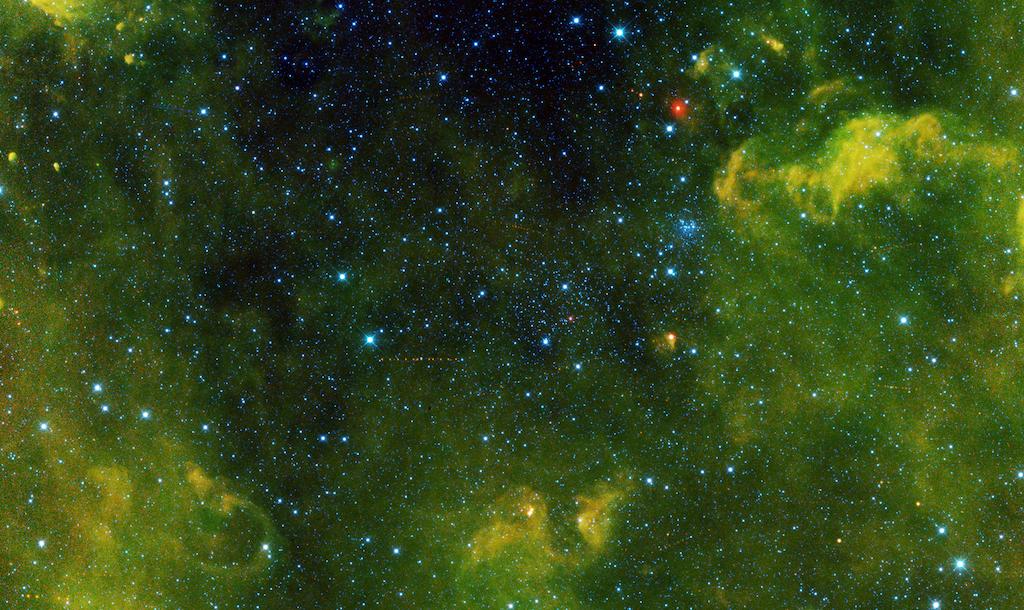
Comets: Comets are dirty space snowballs of mostly ice and dust that formed during the birth of the solar organisation 4.6 billion years ago. Nigh comets have stable orbits in the outer reaches of the solar system past the planet Neptune.
Meteoroids, Meteors, Meteorites: Meteoroids are tiny asteroids or the broken-off crumbs of comets and sometimes planets. They range in size from a grain of sand to boulders 3 feet (1 meter) wide. When meteoroids collide with a planet's temper, they become meteors. If those meteors survive the atmosphere and hit the planet's surface, their remains are called meteorites.
Related: Fallen Stars: A Gallery of Famous Meteorites
Asteroids
At first glance, asteroids may seem similar run-of-the-mill space rocks, merely these aboriginal solar system remnants come in all shapes, sizes and flavors.
Despite their pocket-size stature (the mass of all the asteroids combined is less than Earth's moon), asteroids are also called pocket-size planets or "planetoids." They range in size from the smallest boulders, 3 anxiety across (1 m), to the largest asteroid, Ceres, which is near a quarter the size of Earth's moon (virtually 590 miles in diameter, or 950 kilometers). Ceres is and so large, information technology received a promotion to the status of a dwarf planet in 2006, the aforementioned controversial distinction given to Pluto.
Near asteroids look like giant infinite potatoes, with their oblong shapes and surface that'south pockmarked past numerous craters caused past collisions with other asteroids. Only a modest number of asteroids are large enough that their gravity forms them into spheres, such as Ceres. The limerick of asteroids range from dark, rocky clumps of rubble consisting of clay and silicate rocks to bright and solid amalgamations of metals such every bit iron or nickel, according to NASA.
Nearly all asteroids are found in a doughnut-shaped region betwixt Mars and Jupiter, called the asteroid belt. The belt formed non long after the nativity of Jupiter when the massive planet's gravity trapped planet-forming leftovers, causing them to collide with one another and form the millions of asteroids we see in the belt today.
Comets
For millennia, the sight of a comet elicited fear and awe. Ancient astronomers believed comets foretold the expiry of princes and the outcomes of wars. Modern astronomers know comets are the ice-clad leftovers from the material that formed our solar arrangement billions of years ago.
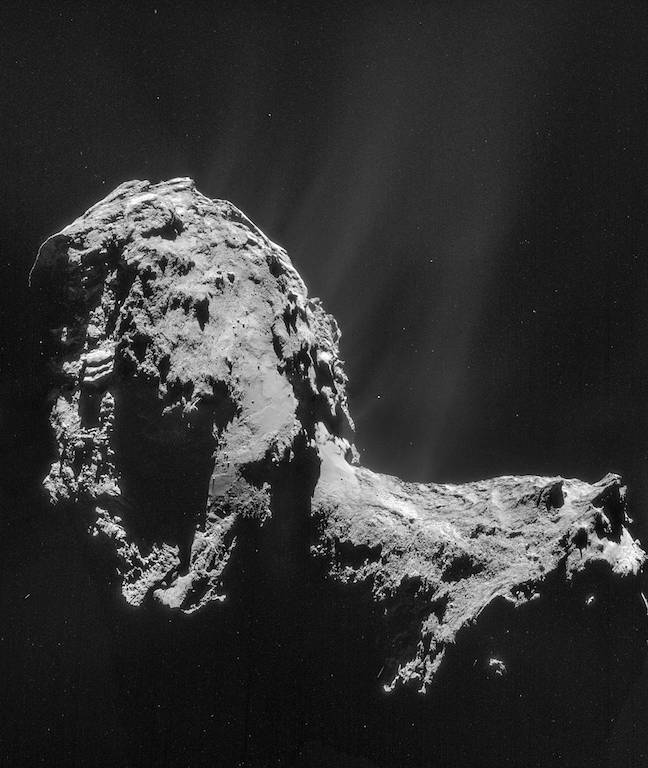
Astronomer Fred Whipple was the first to draw comets as dirty snowballs, or icy conglomerates of frozen gases and dust. The snowball makes upward the central nucleus of a comet, which is often less than a few miles across, according to NASA. When a comet nears the sun, the nucleus warms upwardly and the ice begins to sublimate from solid to gas. This produces an atmosphere surrounding the comet that can grow to thousands of miles in bore, called a coma. Radiations pressure from the sun blows abroad the grit particles in the coma to produce a long, vivid dust tail. A second tail is formed when high-energy solar particles ionize the gas, creating a carve up ion tail.
The difference between the composition of asteroids and comets is likely due to how and where they were born, wrote Britt Scharringhausen, a professor of astronomy at Beloit College in Wisconsin.
"While asteroids and comets did form at the same time, they did non form under quite the same conditions," Scharringhausen wrote. "The solar system formed from the solar nebula, a cloud of gas and dust. At the eye of the nebula, the sun was existence built-in through gravitational collapse. Because of this collapse, which releases heat, the central regions of the nebula were hotter and denser, while the outer regions were libation."
Asteroids formed near the center of the hot nebula where only rock or metal remained solid under extreme temperatures. Comets formed across what's chosen the frost line, where it was common cold enough for water and gases similar carbon dioxide to freeze. Because of this, comets by and large are institute only in the far reaches of the solar arrangement in 2 regions named the Kuiper Belt and the Oort Cloud.
Meteoroids, Meteors and Meteorites
Meteoroids are the true space rocks of the solar organization. No larger than a meter in size (iii.iii feet) and sometimes the size of a grain of grit, they are too small to be considered asteroids or comets, but many are the broken pieces of either. Some meteoroids originate from the ejected droppings caused by impacts on planets or moons.
If meteoroids happen to cross paths with a planet's atmosphere, like Earth'south, they go meteors. The fiery flash given off by meteors when they burn up in the atmosphere can appear brighter than the planet Venus, which is why they've earned the nickname "shooting stars," according to NASA. Scientists guess more than than 48 tons (43,500 kilograms) of meteoritic material falls to Globe every twenty-four hour period. If a falling star survives its descent through the atmosphere and hits the ground, information technology'south chosen a meteorite.
When World passes through the trail of debris left by a comet nosotros're treated to the dazzling fireworks brandish of a meteor shower, where thousands of shooting stars tin be seen in the night sky. The Perseid falling star shower is one of the most spectacular, occuring every year around Aug. 12. At its peak, 50 to 75 meteors tin be seen per hour if the sky is clear. The Perseids are caused by the meteoroids broken off from Comet Swift-Tuttle.
These brilliant shooting star showers serve as a reminder that despite the seemingly empty expanse of space, we're more closely connected to our solar system than nosotros imagine.
Additional resources:
- Learn some very foreign things most comets revealed by the Rosetta spacecraft, from Infinite.com.
- Read about NASA'southward Dawn program, a mission to study asteroids, from Space.com.
- Watch this animation of all known asteroids and comets in the solar arrangement between 1999 and 2018, from NASA Jet Propulsion Laboratory.

Which Of The Following Correctly Describes The Size Of Meteoroids?,
Source: https://www.livescience.com/difference-between-asteroids-comets-and-meteors.html
Posted by: vallejoinginge.blogspot.com
0 Response to "Which Of The Following Correctly Describes The Size Of Meteoroids?"
Post a Comment